
WELCOME BONUS 300%
UP TO €2000 + 100
FREE SPINS
UP TO €2000 + 100
FREE SPINS
Home → Blackjack
Blackjack at Quatro Casino: Variants, Rules and Payouts
Perfect Pairs vs 21+3 in House Edge
The standard Blackjack Insurance side bet carries a 7.47% house edge against a base game RTP of 92.53% when playing with six to eight decks. This high cost significantly reduces the overall return compared to the main game, which typically offers an RTP of 99.54% under optimal conditions. Players lose money faster on this wager than on the primary hand.
In contrast, the Perfect Pairs and 21+3 side bets often feature higher house edges than the insurance option due to their complex payout structures. The casino retains a larger share of stakes placed on these auxiliary wagers during every round.
Wagering requirements treat table games differently, contributing only 10% toward the turnover obligation for the 300% welcome bonus up to €2,000. This means a €100 bet counts as just €10 toward clearing the funds, unlike slots that contribute 100%. Consequently, players must wager much more volume on blackjack variants to unlock withdrawals.
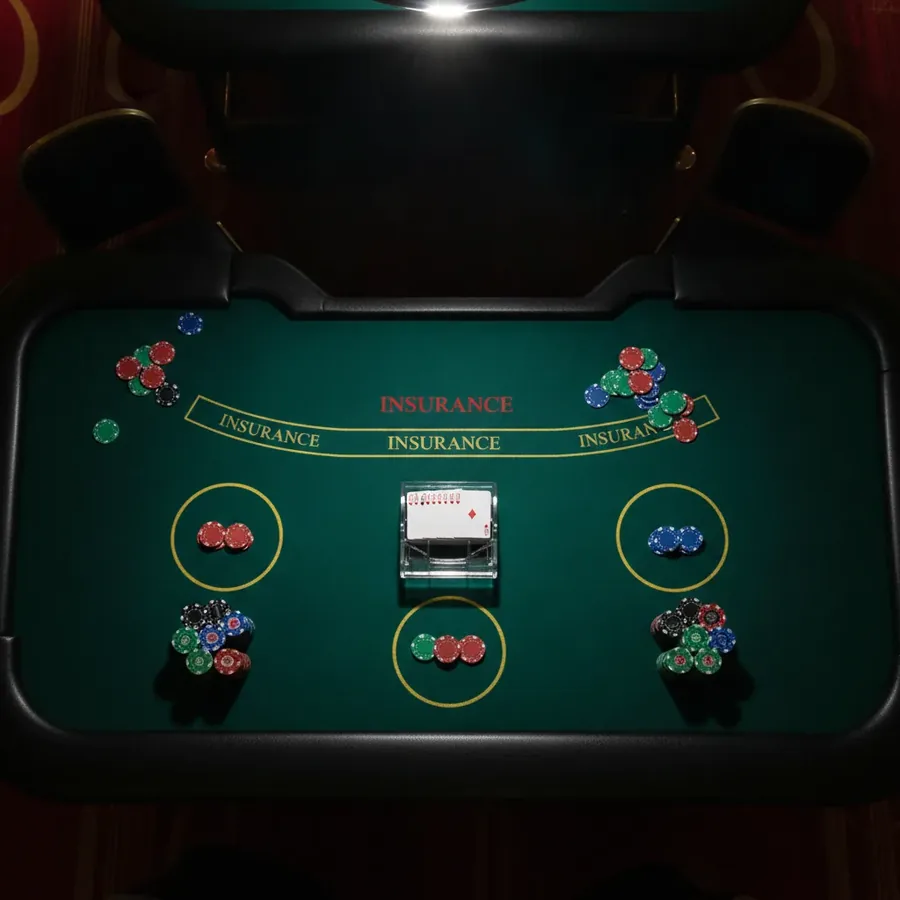
Place Side Bet before cards are dealt
The Insurance wager is strictly conditional, activating only if the dealer shows an Ace after the initial deal. It requires a separate stake equal to half the original bet, paying out at 2:1 odds if the dealer holds a ten-value card. Bets placed after this reveal do not qualify for the insurance protection mechanism.
Basic strategy dictates rejecting insurance unless a player is counting cards with a True Count of +3 or higher. For single-deck games, the house advantage on insurance rises to approximately 5.88%, making it even less favorable for casual players. Most independent analysts recommend avoiding this side bet entirely during standard play sessions.
This exclusion applies to all blackjack variants, including those with liberal rules like Vegas Strip where the base house edge is just 0.28%. The 300% welcome bonus up to €2,000 does not alter the mathematical disadvantage of side bets. Players should focus on the main game to minimize the impact of the 10% contribution rate.
Even Money only possible with Dealer Ace
Even Money is essentially an insurance offer made when a player has a natural Blackjack and the dealer displays an Ace. By accepting this option, the player guarantees a 1:1 payout immediately, neutralizing the risk of a dealer Blackjack push. This decision locks in the win regardless of the dealer's hidden hole card value.
Declining Even Money allows the player to retain the full 3:2 payout potential, which yields €150 on a €100 wager instead of €100. However, if the dealer also holds a Blackjack, the result is a push rather than a loss, preserving the original stake. Statistical analysis suggests that declining is mathematically superior for most strategy levels.
The 6:5 payout structure found in some tables drastically reduces the value of a natural Blackjack to only €120 on a €100 bet. This rule change adds 1.39 percentage points to the house edge, making Even Money slightly less critical but still costly. Players using the 300% welcome bonus up to €2,000 should avoid 6:5 tables entirely.
Blackjack Party runs with two hosts
Evolution’s Blackjack Party table features a unique party atmosphere facilitated by two live moderators guiding the session. The betting limits range from 1.00 EUR to 1.000 EUR, accommodating both low rollers and high-stakes participants. This format emphasizes entertainment value over pure strategic efficiency.
The standard deviation for this variant is notably high, reflecting the volatile nature of side bets and multi-round interactions. Unlike traditional tables, the social dynamic influences the pace, though the underlying RTP remains consistent with other Evolution offerings. Players must navigate the 10% contribution rule for the 300% welcome bonus up to €2,000.
Side bets like Perfect Pairs are integrated into the flow, offering payouts that can skew results significantly from the theoretical RTP. The presence of two hosts ensures constant engagement, but the house edge on these auxiliary wagers remains steep. Strategic play is complicated by the interactive elements introduced by the live team.
Unlike Lightning Blackjack which offers multipliers up to 25x, Blackjack Party relies on standard payouts without random multiplier events. The maximum win cap is determined by the table limits rather than external modifiers. Players seeking consistent returns should prioritize standard rules over themed variations.
Live stream with three cameras and OCR
Playtech’s Quantum Blackjack Plus Live utilizes advanced technology to track cards via Optical Character Recognition (OCR) across multiple camera angles. This system enables the application of quantum multipliers up to 1,000x on specific three-card combinations totaling 21 points. The technical setup ensures precise detection of winning hands for automated payouts.
The betting range spans from 1 EUR to 5,000 EUR, allowing high rollers to capitalize on the rare multiplier events. With an RTP of 99.57% under optimal strategy, this table offers better theoretical returns than many standard variants. However, the volatility remains extreme due to the reliance on random number generation for multipliers.
The 300% welcome bonus up to €2,000 applies equally to live dealer games, subject to the 10% contribution limit. A €100 bet on Quantum Blackjack Plus contributes only €10 toward the wagering requirement. Players must generate significant turnover to clear the bonus, making bankroll management essential.
Blackjack variants at a glance
| Variant | Payout | House edge | Rule | Bet range |
|---|---|---|---|---|
| Blackjack 6 Decks, S17, DAS, DOA, Auszahlung 3:2, Basisstrategie | 99.54% | 0.46% | Dealer steht auf Soft 17; Verdopplung auf jeder Zweierkarte; Verdopplung nach Split erlaubt; keine Aufgabe. Basisstrategie ist für diesen Wert zwingend | Blackjack 3:2, normaler Gewinn 1:1, Insurance 2:1 |
| Blackjack Ein Deck, klassische Regeln, 3:2 | 99.85% | 0.15% | Weniger Decks = niedrigerer Vorteil; ein Deck gibt ca. −0.48 Prozentpunkte gegenüber 8 Decks. Oft durch 6:5 Auszahlung kompensiert. | Blackjack 3:2, Gewinn 1:1 |
| Blackjack Auszahlung 6:5 statt 3:2 (6 Decks) | 98.15% | 1.85% | Ersatz von 3:2 durch 6:5 fügt exakt +1.39 Prozentpunkte zum Vorteil des Casinos hinzu – stärker als jede andere Regeländerung. Bei $10 Einsatz zahlt Blackjack $12 statt $15. | Blackjack 6:5, Gewinn 1:1 |
| Blackjack Liberal Vegas Strip (liberale Regeln, 3:2) | 99.72% | 0.28% | Günstigste Regelkombination: S17 + DAS + Resplit + Late Surrender. Standardabweichung 1,15 | Blackjack 3:2, Gewinn 1:1 |
| Blackjack Split / Double / H17 – Regel-Effekte | n.a. (Regel-Modifikatoren) | H17 +0.22 Prozentpunkte; RSA −0.08 Prozentpunkte; DAS −0.14 Prozentpunkte | Dealer Hits Soft 17 verschlechtert RTP um 0.22 Prozentpunkte; Resplit Aces verbessert um 0.08 Prozentpunkte; Double After Split verbessert um ca. 0.14 Prozentpunkte; 6 Decks statt 8 – ca. 0.02 Prozentpunkte. | Double – Einsatz ×2 mit einer Karte; Split – bis 4 Hände; Ass-Split meist mit einer Karte. |
| Blackjack Surrender (Late Surrender) – Regel-Effekt | n.a. (Regel-Modifikator) | −0.08 Prozentpunkte | Spieler gibt Hand nach Dealer-Blackjack-Prüfung auf, verliert die Hälfte des Einsatzes. Verbessert RTP um ca. 0.08 Prozentpunkte. Early Surrender ist wesentlich wertvoller (bis −0.6 Prozentpunkte), aber extrem selten. | Rückzahlung 50% des Einsatzes |
Insurance vs Even Money on Own Blackjack
The Insurance side bet offers a 2:1 payout when the dealer shows an Ace, but it carries a high house edge of 7.47 percent for six to eight decks. This negative expected value contrasts sharply with the standard game RTP of 99.54 percent, making the wager statistically unsound for long-term bankroll preservation. Players should reject this option unless counting cards reveals a true count of plus three or higher. Even Money acts as a simplified insurance bet on a natural blackjack, locking in a 1:1 profit immediately. This choice removes the variable of the dealer checking for blackjack and guarantees a win regardless of the hole card. The decision impacts the bonus turnover requirement because table games contribute only ten percent toward the wagering goal.
What doesn't count as Blackjack after Split?
When players split Aces, most rules restrict receiving only one additional card per hand, which eliminates the possibility of drawing multiple cards to improve the total. This limitation prevents achieving the full potential of the 99.72 percent RTP found in liberal Vegas Strip variants that allow resplitting. The restriction effectively increases the house edge by removing strategic options available in other blackjack formats like the six-deck S17 game. Splitting allows up to four hands, but doubling after split is often limited to specific totals or prohibited entirely on split Aces. These rule variations directly affect the theoretical return, shifting the advantage from the player to the casino by significant margins. Understanding these constraints helps manage expectations regarding the 300 percent welcome bonus eligibility for table game contributions.
Live Table vs RNG Table: Speed and Limits
Lightning Blackjack by Evolution features betting limits ranging from one to two thousand five hundred euros, accommodating high rollers seeking multipliers up to twenty-five times. Quantum Blackjack Plus by Playtech extends these limits to five thousand euros while offering massive multipliers of up to one thousand times for specific three-card combinations totaling twenty-one points. These live tables operate at a slower pace than RNG versions due to physical dealing, affecting the hourly volume of wagers eligible for bonus turnover. The party atmosphere at Evolution's Blackjack Party table includes two moderators, creating a distinct environment compared to the solitary digital experience of RNG software. Live dealer games contribute ten percent to the wagering requirement, whereas slots contribute one hundred percent, influencing the strategy for clearing the bonus funds. Comparing these environments highlights the trade-off between social interaction and rapid progression through bonus terms.
Side Bet Every Round: Budget Lasts 30 Rounds
Placing the Insurance side bet every round consumes a portion of the bankroll that could otherwise be used for primary wagers contributing to the bonus turnover. With a house edge of seven point four seven percent, this recurring cost drains funds faster than standard play, reducing the total number of rounds affordable. A budget allocated for such consistent side bets might last approximately thirty rounds before depletion, significantly impacting the ability to meet the wagering requirements. The standard game RTP of ninety-nine point five four percent suggests that primary bets preserve capital more effectively than auxiliary wagers. Players must balance the desire for insurance protection against the mathematical certainty of losing value over time due to the high house edge. This calculation underscores why relying on side bets is incompatible with efficient bonus clearance strategies under the current terms.
Bonus 100 EUR with 10 percent credit
A deposit of one hundred euros triggers a bonus credit calculated at ten percent of the deposit amount, resulting in a specific bonus value derived from the base sum. This modest credit contrasts with the advertised three hundred percent welcome bonus, indicating different promotional tiers or conditional eligibility based on initial gameplay. The ten percent contribution rate for table games means that wagers placed on blackjack variants advance the wagering requirement slowly compared to slot machines. Clearing the bonus requires generating substantial turnover, as the low contribution percentage extends the time needed to unlock withdrawable funds. Players utilizing the 100 EUR bonus must account for the house edge of various blackjack games, such as the zero point forty-six percent advantage in six-deck variants. Strategic play becomes essential to minimize losses while satisfying the turnover conditions imposed by the operator's bonus structure.
Blackjack doesn't count for every bonus offer
Tischspiele contribute only 10 % to the wagering requirement for the 300% welcome bonus up to €2,000 plus 100 free spins, whereas Slots contribute 100 %. This means that a €10 bet on a table game counts as just €1 towards clearing the turnover target. Players must therefore rely primarily on slot wagers to meet the full bonus conditions efficiently. Table game contributions are significantly lower than the standard slot contribution rate.
The limited contribution of Blackjack variants like Lightning Blackjack or Quantum Blackjack Plus Live restricts their utility for bonus conversion. Since these tables offer high RTP values around 99.56 %, they are poor tools for meeting high wagering multipliers attached to the €2,000 max bonus. A player betting €100 on such a table adds only €10 to the required turnover sum. This discrepancy forces a strategic shift away from table games during the active bonus period.
Bonus conditions often exclude Blackjack completely
Certain promotional terms explicitly exclude all Blackjack variants from bonus eligibility, rendering the 300% welcome bonus up to €2,000 plus 100 free spins unusable for these games. If a casino enforces this exclusion, players cannot use table stakes to satisfy any portion of the wagering requirement. The entire burden then falls on slots, which contribute 100 % to the turnover calculation. This total exclusion eliminates the strategic advantage of playing low-house-edge games.
One Deck vs Eight Decks in House Edge
One Deck Blackjack offers a superior house edge of 0.15 % compared to the 0.46 % seen in six-deck variations with standard rules. The reduction in decks lowers the casino's advantage by approximately 0.48 percentage points relative to eight-deck shoes. However, many casinos compensate for this by paying 6:5 instead of 3:2 on blackjack payouts. This rule change increases the house edge to 1.85 %, negating the benefit of fewer cards.
Six Decks to Eight Decks in the Shoe
Increasing the number of decks from six to eight raises the house edge slightly, adding about 0.02 percentage points to the casino's advantage. While minor, this shift affects the overall RTP when combined with other restrictive rules like H17 or lack of surrender. Six-deck games with S17 and DAS typically maintain an edge of 0.46 % under optimal play. Moving to eight decks without compensating rule improvements reduces player returns marginally.
Contact
Live - online chat
Banking





Providers












Quatro Casino 2026